Showing posts with label Upton. Show all posts

Monday, 12 November 2012

My God!!!! There's a car coming from the right!!!

Date: October 2012
Test Centre: Upton
Reason for fail: Control - Steering.


Cassie failed because she steered into the kerb as she approached a roundabout near a place called Thurstaston. Really though, the issue isn't what she was doing with her hands, it was what she was doing with her eyes.

When you arrive at a junction (a roundabout is a junction!), ideally, you'll have done everything you need to do before you get there. If you arrive at the right speed, in the right road position, in the correct gear, then when you look right and decide whether it's safe to go or not, it will be easy for you. To sort all that stuff out, you need to look where you're going.

The reason Cassie looked right instead of where she was going? Well because she was nervous. That's just what nervous drivers tend to do. And then, if there's a car coming from the right, they tend to just keep looking at the oncoming car, and panicking. And that's just what Cassie did. So she bumped into the kerb because she'd drifted out to the right as she approached.

Sunday, 7 October 2012

How to turn a drama into a crisis!

Date of Test: August 2012
Test Centre: Upton
Reason for fail: Turn in Road, Observation; Move off, Safely.

Carrie Ann was nervous. She always is when what she's doing is put under scrutiny. She's never liked tests of any kind, and the Driving test was something she'd been dreading.

Still despite her fear, she was prepared to have a go, and so it was that in August 2012, she presented herself at Upton driving test centre for her second attempt.

Generally, she coped well with the drive but two things happened that caused her to fail.

Firstly, she did the reversing component of the turn in the road by looking out of her front windscreen instead of looking where she was going. This meant she was far more likely to bump into the kerb, but more importantly, if anything had been behind her, like a pedestrian or cyclist, she would not have seen them. She picked up a serious fault for observation.


I was sat in the back for this one, and I could see the examiner's test sheet. He didn't actually mark the fault until the end of the test, so I hoped he might just mark it as a minor fault. Perhaps if the second thing hadn't happened, he would have.

The second thing was a right turn at the end of a one way street in Irby.


Carrie Ann was unsure of herself here. Moving to the right hand side of the road often feels wrong even though it's the correct thing to do if you're turning right. But, slightly hesitantly, she got herself in the right place. The junction offers good visibility to the left, but it's not quite as open from the right.

Carrie Ann moved forward far enough to get a clear view to the right. The road was clear to her left, but there was a bus approaching from the right. This bus was a fair distance away, and there was a gap for her to get into. She attempted to move away, but had forgotten to change into gear one. As she brought her clutch up, the car stalled.

Carrie Ann panicked and pressed her brake pedal. This caused her to stop in the middle of the road, and forced the bus to have to stop. Eventually, she got the car running, put the car into gear one, made sure it was safe to move off, and off she went.

Most people have a misconception. That misconception is that you move away by bringing your clutch up. But what you should really do is get your footwork sorted before you move away. Us instructors call it setting your gas and finding your bite. Pressing the accellerator provides the engine with the power it needs to move a ton of metal from a standing start. The clutch controls that power. So when you move away, you do it by keeping your feet still. Releasing the handbrake will make the car move smoothly forward, even if you're in second gear.

But everyone stalls from time to time. If you want to really cause a problem to other people with your stall, you should slam on your brakes as well.

Alternatively, what you can do is put your clutch down and start your engine. If you stalled because you brought your clutch up, make sure it's still safe to go, and just move away without bringing your clutch up. If you stalled because you were in the wrong gear, put the car into the right gear, make sure it's still safe to go, and move away withough bringing your clutch up.

Monday, 14 May 2012

Didn't pass. Didn't fail....

Test Centre: Upton
Reason For Fail: N/A

This morning, at the crack of dawn, I got up, and picked up my pupil for his driving test.

We went through the manouevres, and did some tight slow roads to get him dealing with things defensively, and we got to the test centre at about 8:10 am.

There were 4 candidates on test, but only 3 examiners came out. One of them called me and my pupil to one side. One of the examiners had not been able to make it to work because of illness, and because it was the first test of the day, there hadn't been time to arrange cover.

Since there was no examiner to conduct the test, it could not go ahead.


Ouch! You could have had a lie-in!

I could. But I'd have missed out on being paid for the work.

You mean your pupil had to pay you?

Well yes. I got up at half past 6, and gave him a lesson, and I couldn't have taught anyone else in the time he was supposed to be on test, so in that situation, us instructors will expect payment.

But doesn't that mean your pupil lost out?

No. My pupil will be given a free re-test, and any expenses he incurred, such as the money he paid me, and compensation if he'd taken time off work to do the test are reimbursed by the Driving Standards Agency. It was their responsibility to ensure they had an examiner available, and because they failed to fulfill their responsibilities, they had a duty to provide an alternative date, and to compensate the candidate for any losses he incurred.

So how do you go about claiming the money back then?

You need to go to this webpage - http://www.direct.gov.uk/en/Diol1/DoItOnline/DG_196463?CID=Motoring&PLA=url_mon&CRE=driving_test_expenses

You'll find a link to a pdf document which tells you more about it and includes an application form.

http://www.direct.gov.uk/prod_consum_dg/groups/dg_digitalassets/@dg/@en/@motor/documents/digitalasset/dg_196447.pdf

Simply print off the form, complete it, and send it to the address shown in the first link.

Tuesday, 1 May 2012

Poor at Parallel Parking? Practice Precise Positioning!

It's been a while since I had anyone fail! This is a good thing of course, but it's also meant I've had little to say on this blog for the last few months.


Test Centre: Upton

I was sat in the back for this one. My pupil, Neil, was relaxed and confident on the pre test lesson, but when it came down to the real thing, he got a bit of the fear in him. And it showed.

He was asked to do a parallel park in Sparks Lane, Thingwall and ended up putting his wheels up on the pavement. The examiner let him try to sort it out for a little while, then when he couldn't correct it, asked him to move on.

The mark Neil got on his test sheet was a serious fault, reverse parking (road) - Control.

We'd actually done a parallel park as part of the pre test lesson. Neil did it quite well. He didn't do it in the structured way I'd taught him, but what he did do seemed to work for him so I left it at that. Shame really. If he'd made a mess of it, we would have done a bit more on it, and he might not have got it wrong when it mattered.

If you do get it wrong, and touch the kerb, you haven't at that point failed your test. Generally if you try to reverse further you're going to make matters worse, so if you do touch the kerb, put the car into first gear, Check it's Clear Around You!!!!, and correct it by going forwards. Often, if you can fix it, the examiner will mark it as just a minor fault.

Thursday, 5 January 2012

The clues are subtle, but they're there.

Today, Laura failed her test because she couldn't work out how to deal with an unusual and complex junction.

Here's how the junction looks on Google Earth:

Laura was heading up the road towards the semi-circular junction, with the ultimate aim of turning right when she reached the dual carriageway at the top of the picture.

Here's how it looks on streetview:

As you approach the junction, it's not particularly obvious how you should deal with it. You really shouldn't turn right, but there are no no entry signs to help you. Just one solitary bollard with a keep left arrow on it.

This bollard is a bit more visible in this next picture:

A bit...

Laura came up to this bit too quickly, and didn't really have time to either read the complexities of the junction, or to safely assess whether it was safe to proceed. She did turn left, but it all fell short of the standard of driving required.

Having turned left, she was immediately confronted by a right turn onto a dual carriageway. The central divide is narrow, and ideally, you would want to complete the manouevre in one go, rather than putting yourself in a vulnerable position, half way across the road.


This is one of the most complex and challenging junctions on any of the Wirral test routes. But it is understandable, if you break it down into it's constituent parts.

Sunday, 19 June 2011

Righting wrongs

Date: January 2011
Test Centre: Upton
Reason for fail: Serious fault, Use of Mirrors - Change speed


This is a fairly busy roundabout between Greasby and Upton. It has a small niche of a road off to your right, that leads into a short dead end, where people sometimes park their cars. This causes people to signal late if they want to take the exit before the one that's being approached in the picture above.

Steve came to this situation on his driving test. Unsure of whether he had a safe gap, he didn't really get himself sorted out, and he stalled because he was going much too slowly for third gear.

Scott abruptly stopped the car, put his clutch down and his handbrake on. He started his engine, and put the car into gear one. Then he moved away safely. The abrupt stop caused the person behind to get very close, and they themselves had to do an emergency stop. Perhaps other people further back also had to stop very quickly.

OK. So everyone stalls now and again. How should you sort it out?

First thing to do was to check the mirror! Everyone gets it wrong from time to time, and if you do find yourself off the straight and narrow, you need to keep yourself safe. This means being aware of what's going on around you. Stopping suddenly may not be the best course of action, expecially approaching a roundabout, where the person behind you may well be looking right to see what's coming, instead of looking where they're going. In this case, what Scott should have done is put his clutch down, sort out first gear, and start his engine. Even if it meant going over the give way line a bit (the vehicle that caused Scott to panic had turned off to the left without signalling)

People stall for two main reasons. As Scott found, the car will stall if you slow down or stop in a a high gear, and the clutch up. The other time is when people move off, either bringing the clutch up too quickly, or in the wrong gear, or without enough revs. If you can minimise the effect your stall has on other road users, you're much more likely to get away with a minor fault than if you do something that causes other people to have to react sharply.

Saturday, 18 June 2011

Keep left...

Date: May 2011
Test Centre: Upton
Reason for fail: Serious fault, Positioning - Normal driving


Liz has just gone through a set of traffic lights. She was in the right hand lane because a car was indicating left in the left lane, so she used the lights to overtake this slow moving vehicle safely. Unfortunately, she stayed out in the right lane, and wasn't going particularly quickly. When a car overtook her on the left, the examiner was always going to give her a serious fault.

What should Liz have done?

She should have been looking in her left door mirror to make sure she was past the car she was overtaking, with a view to getting back to the left as early as possible. By staying out to the right, she made it difficult for herself to get safely back over, because of cars coming up on her left. It would have been better if she'd been a bit more assertive, as she would have gained the space to move over safely. Accellerating while changing lane takes you away from the danger,

Monday, 6 June 2011

It's just a shame that's all...

Date: April 2010
Test Centre: Upton
Reason for fail: Turn in Road - Observation


Kathryn was asked to do a turn in the road. She got ready, checked it was clear around her and moved slowly across the road. She stopped, and put her handbrake on, then prepared herself, and made sure it was clear around her. As she reversed slowly back, she saw an old man walking along the pavement. Alert to the possibility that might walk out into the road, she kept still and waited until he had gone past and then continued to reverse, before putting her handbrake on, getting ready, checking around and completing the manouevre.

Huh? She got a serious fault for that? Why?

She had been sat still for quite a long time in the middle of the road, and didn't look both ways before continuing. If a cyclist had been coming or something she might have hit them. The examiner had no option but to give her a serious fault. If she'd looked around after waiting for the pedestrian, or if she hadn't waited for him in the first place, she wouldn't have got the fault. her kindness turned around and bit her on the ass.

Busload of trouble...2

Date: 2007
Test Centre: Upton
Reason for fail: Awareness/planning


The Royal Mail van is driving past a bus stop on Woodchurch Road, in Birkenhead. Buses have to stop on the road itself. There is no lay-by for them to pull into.


Jameele was following a bus down this road when it signalled left. As the bus slowed, he got closer and closer to it and had to slow down. This meant that traffic in the right hand lane was now coming up from behind too quickly for him to get around the bus safely, and so he had no option but to stop close behind it and wait until it had pulled away.


Ouch! He could have been stuck there for ages! What should he have done instead?


As soon as the left indicator of the bus went on, Jameele should have checked his right hand door mirror. If he'd had a safe gap he could then have moved out into the right hand lane. If it wasn't safe to immediately move over, he would need to tell other drivers what he wanted to do, by signalling right, and kept as far back as he could. Generally, drivers in the right hand lane can see what the situation is and will often hang back to allow a vehicle signalling right to move out. If they don't, and you do have to stop in the left hand lane, it's better to have plenty of room in front of you, as this gives you more room to get out, and allows you a better view of what's going on beyond the bus.

Busload of trouble...1

Date: 2009
Test Centre: Upton
Reason for fail: Use of Mirrors - Change speed


This isn't the actual bus. I don't have a video camera mounted on my car, recording tests. As far as I'm aware, such a thing would be frowned upon. I use google street view instead, and this picture is just to give you an idea that this one concerns a bus, just in case the title wasn't enough.

The bus was stopped at a bus stop as John approached it on his driving test. Having let off or on everyone that wanted to get on or off, the bus driver signalled right to say he wanted to move off.

John's reaction was instant! He was going to let that bus out! He braked sharply, and a man driving a van behind him had to brake even more sharply.

Not good. How could John have done it better?

Bus drivers are often working to a deadline.When they want to move away they signal right and often start to move slowly off. Then they check it's clear and if it isn't, they wait. the right signal doesn't give them the right to pull out in front of people. John should have checked his centre mirror, seen that it wasn't safe to stop, and carried on past the bus. If he'd checked his mirror, and the road had been empty behind him, he could of chosen to be courteous and allow the bus to move off, because he wouldn't have caused a danger to others.

Sunday, 5 June 2011

Wrong lane blues

Date of Test: May 2011
Test Centre: Upton
Reason for fail: Use of mirrors - Change Direction


Karen was in the middle of the "independent driving" section of her driving test. She had been asked to turn left at this junction, but unfortunately ended up in the right hand lane. She realised that she was going the wrong way, and attempted to suddenly change lane, without looking in her left hand door mirror first.

A lorry was to her left, and the examiner hit the brakes, in order to avoid a collision. Not surprisingly, she got a serious fault for it.

So if she'd just gone right, she'd have passed?

Yes. The examiners mark your driving, not your ability to remember a series of directions. Everyone gets it wrong from time to time, and it's important that you do the safest thing, rather than just forcing your way into a different lane. You can always find a way to get back on track somewhere further on. If you do find yourself in the wrong lane, the first thing to do is to check your mirrors, so that you know how you will affect other people if you choose to try to correct it. If you have the time and space, a signal can tell people what you intend to do (but it doesn't give you the right to do it - have another look after you've signalled to see if other road users are giving you the space you need) If it's not safe to change lane, just keep in the lane that you're in, and go the wrong way. The examiner can then give you a couple of instructions to get you back on route.

Friday, 3 June 2011

Get a move on, sunshine!

Date of Test:  2006
Test Centre: Upton, Merseyside
Reason for fail:  serious fault, Progress - Appropriate Speed


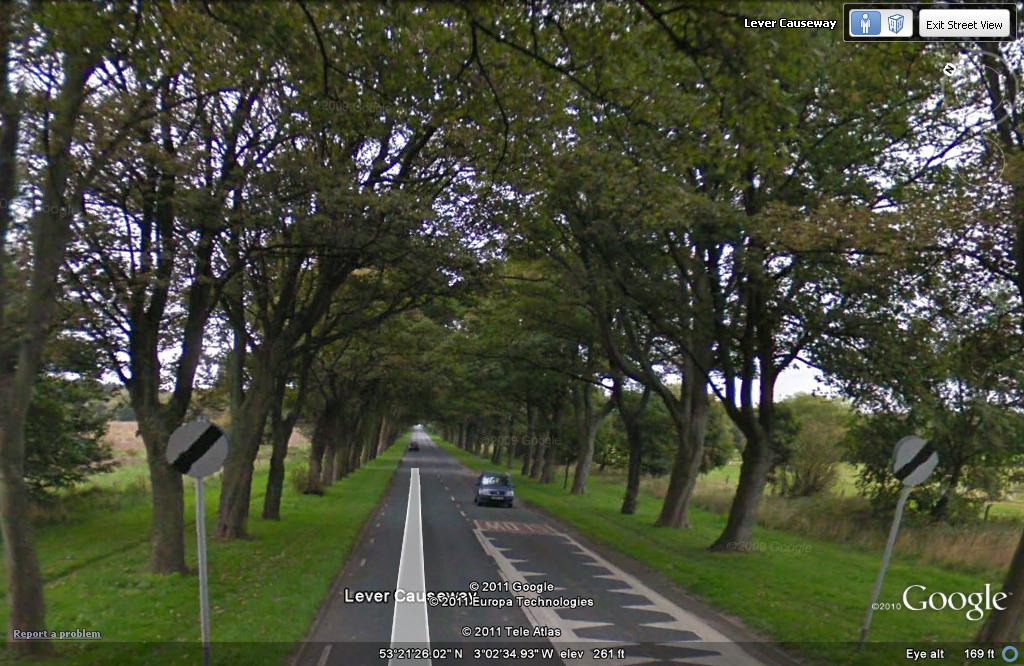
This is Lever Causeway. It's a mile long, perfectly straight, tree lined road. Beyond the black and white signs in the foreground, the speed limit for it is 60 miles per hour.

But Danny, on his driving test, and with the idea that he had to do everything slowly, went up this bit of road at a nice steady thirty.

He caused havoc! People were trying to overtake, but having to swerve back in because of oncoming traffic. He acquired an ever growing tail of frustrated drivers behind him. He knew how to drive on fast country roads, but he just got the wrong idea of what was required of him, and the examiner had to give him a serious fault.

OK. So how do you deal with a situation like this?

I think the first principle here is that you must be able to sto pwithin the distance you can see. If you're on a narrow and bendy road, and you come to a bend with a tractor stopped dead in the middle of the road, you really do want to be able to stop in time.

The road markings can help you here too. Long white lines with short gaps mean there are hazards around. Short white lines with long gaps tend to occur when the road is clear.

Being able to drive properly does not mean doing everything slowly. It means doing everything at the right speed, and sometimes, when you have a clear and open road in front of you, you should be prepared to travel at the speed limit.

Keep left!

Date of Test:  June 2011, 12.43pm
Test Centre: Upton, Merseyside
Reason for fail:  serious fault, Positioning - Normal Driving


Apart from getting things wrong at the end of a one way street, Fred also picked up a serious fault on a bit of road with more than one lane. The road had two lanes for westbound traffic, and there were some parked vehicles on the left, forcing traffic out into the outside lane. After the last of these parked cars was passed, Fred checked his mirrors and sigmalled left, and started to move to the left, but had to abort the lane change because of a lady in a BMW aggressively overtaking on his left. He could have done with breaking down the MSM stuff there into M----S----M, rather than it all happening in a vvery short space of time, but this wasn't where he got a serious fault. His driving was good enough to keep himself safe, and the examiner recognised that Fred was travelling at the speed limit, and that the BMW driver was at fault for breaking the speed limit and illegally overtaking on the left.

But a few hundred yards further on, Fred had to move out to the right hand lane again, because of a parked van, and this time he made no attempt to get back to the left after passing the obstruction. A car once again overtook him on the left, but this time he was travelling a little too slowly (the speed limit changed from 30 to 40 mph around this point) and he'd had plenty of time to get back to the left.

Well what was the proper way of doing it?

There has to be a reason for you to be in the right hand lane. If you're overtaking another vehicle (moving or parked) or some other obstruction like roadworks or something, fine. Get out there and stay out there until you know you're clear of whatever it is you're overtaking. If you want to turn right fairly soom, again, there's a good reason for you to be out to the right.

But in the absence of those reasons, keep left. It's safer. It allows other drivers to overtake you legally. It shows that you're reading the situation properly.

This is a really common fault! I had a pupil fail her test for thesame thing in the same place a couple of weeks ago, and a different pupil made the same error on a different stretch of road, but with the same mark on the test sheet: Serious fault, Position - Normal Driving and the same outcome: Failed test.

It's the end of the road for Fred!

Date of Test:  June 2011, 12.43pm
Test Centre: Upton, Merseyside
Reason for fail:  serious fault, Junctions - turning right

I was sat in the back for this one, so I saw exactly what happened, and the driving examiner called it exactly right.

"Fred" got to the end of a one way street and was asked to turn right. He should have positioned himself over to the right hand side of the road, but kept to the middle of the road. The danger is that another driver will come down your outside, and potentially you then have two cars alongside each other, both wanting to occupy the same space at the same time. It also shows a lack of attention or understanding to road signs and road markings.In this case a car behind us positioned itself correctly, but the driver wisely stayed behind us, but even if no other vehicles had been involved, this would have been marked as a serious fault.

So, what should he have done then?

Well the clues were there. The double row of broken lines extending right across the full width of the junction, and the give way triangle right in the middle of the road, instead of off to the left, are big clues. Another thing that can help is the backs of the circular no entry signs. There were one way signs at various points along the road, and all the parked cars were facing in the same direction. So Fred should have been aware that he was in a one-way street and should have positioned himself well to the right.

In fact, by the time he got to the end of the road, he sort of knew things were not right, but did it anyway. If he'd cancelled his signal and gone straight ahead, it would have been safer, and he would probably have just got a minor fault for incorrectly signalling. It would then be upto the examiner to get Fred back onto whatever route he was meant to be following. With a few exceptions, like trying to join a motorway, or attemting to turn into a no-entry road, you don't get failed for going the wrong way.